August 10 - August 26, 2026 | Lynn Clausen &...
Smolny Associate Degree Online Program
The Smolny Associate Degree is a two-year online program that represents the first stage of higher education. Upon successful completion, graduates are awarded the Associate of Arts degree from Bard College.
Admission 2026
Applications for this program are accepted via online form (see link below).
For reference, the admission requirements are as follows:
– Up to 2-minutes motivation video
– A sample of your academic writing in English, written independently and without the use of automated translation or AI tools (waived if you’ve completed an English-language SBB course with grade B+ or higher)
– High school Diploma / transcript
– CV/resume
– Proof of English proficiency (B2 level; standard tests (including Duolingo test scores) are accepted. For minimum and recommended scores, please refer to the FAQ section.
– Contact information for two references who can attest to your academic preparedness (waived if you’ve completed a SBB course with grade B+ or higher)
Shortlisted applicants are invited for an interview.
Please note: We can not accept students who are currently located in the Russian Federation, Republic of Belarus, or North America.
Questions? Write to us at [email protected].
Who can apply
The program is intended for Russian-speaking displaced students from the Eurasian region affected by the war in Ukraine or by authoritarian regimes in the former CIS states. It offers an opportunity for students who are not yet able to attend an international university — due to financial, logistical, or other challenges — to begin or continue their undergraduate education.
Liberal Arts Approach
The educational program builds on Bard College’s expertise in the liberal arts—an approach to learning that centers on the individual, primarily through small group seminars designed to foster thoughtful, critical discourse in an inclusive environment. The program aims to prepare students to be engaged citizens and to promote rigorous, open inquiry, intellectual ambition, and creativity.
Why Choose the Smolny Associate Degree Online Program
This program provides exiled students with a valuable pathway toward higher education abroad. Graduates of the program may continue their studies at Bard Network institutions (starting from the third year and pending admission to these institutions) or transfer their credits to other universities. However, SBB bears no responsibility for admission or financial aid decisions made by institutions within the Bard College network.
Tuition and Financial Aid
Before financial aid, tuition expenses total $5,000 per year.
Thanks to generous financial support, students can receive tuition discounts of up to 90%. In special circumstances, additional financial assistance — including full tuition coverage — is available.
We encourage all interested and eligible students to apply, regardless of their financial status.
Program Curriculum
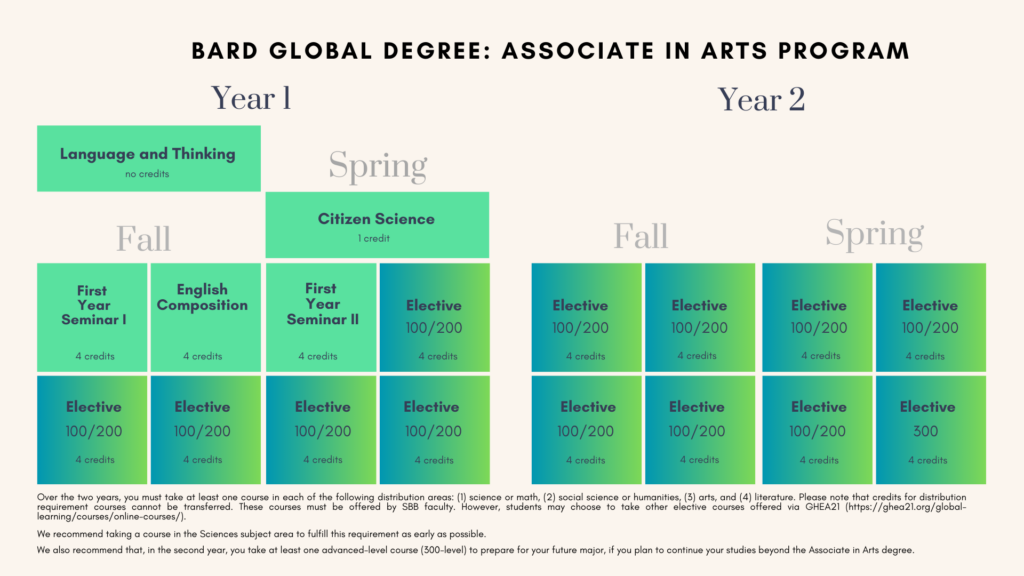
Over the course of two years, students will develop their learning skills through core liberal arts courses, including Language and Thinking, two semesters of the First-Year Seminar, and Citizen Science, and explore different disciplines in Arts; Languages and Literature; Science, Mathematics, and Computing; and Social Studies. The Program also includes an intensive English-language course. Students will have the opportunity to study in virtual, seminar-style classrooms alongside students from across Bard’s global network, learning with and from each other.
To graduate, students must complete a total of 64 academic credits. The standard course load is 16 credits per semester. In addition to the required courses, each student must complete at least one four-credit course in each of the four disciplines and one advanced-level course. Students may transfer up to 12 credits, but all transfer requests are considered only after successful completion of the first semester.
Required Courses
First-Year Seminar I
Fall 2026 | Victor Apryshchenko & Denis Skopin
English Composition
Fall 2026 | Lynn Clausen & Natalia Fedorova
Citizen Science
Spring 2027 | Evgeniya Polyakova & Michael Allakhverdov
First-Year Seminar II
Spring 2027 | Ilya Kalinin & Pavel Kononenko

Electives
All full-semester elective courses (4 US / 8 ECTS credits) in the program fulfill one of four distribution requirements: Arts; Languages and Literature; Science, Mathematics, and Computing; Social Studies. Students must complete at least one course in each of these four distribution areas. In their second year, students are also required to take at least one advanced (300-level) elective course carrying four credits.
These courses are not only electives within the Associate Degree Program curriculum, but are also available as standalone courses. Applicants who are not enrolled in the full degree program are welcome to apply for individual elective courses and participate on a non-degree basis. However, students in the associate degree program have priority enrollment in elective courses.
The list of elective/standalone courses for the Fall semester will be updated and published soon. The current list is provided to give prospective students an idea of the range of courses typically offered. Beginning in the second semester, students in the Smolny Beyond Borders Associate Degree Program may also select elective courses from the GHEA21 online offerings.
Arts
The Private Individual in Culture
Maria Chernysheva | S26 Tue Thu
Diary Film, Auto\Ethnography, and Poetic Film Writing
Masha Godovannaya | S26 Mon Wed
Time Machines: Clocks in History of Technology and Contemporary Art
Natalia Fedorova | S26 Thu
Introduction to Film Language
Masha Godovannaya | F26 Mon Wed
Mimesis in the Art and Thought of the Renaissance
Maria Chernysheva | F26 Tue Thu
Languages and Literature
Literature and Photography
Larissa Muravieva | MAR – APR S26
Narrating Trauma
Larissa Muravieva | FEB – MAR S26
Literature after The War: Genres, Themes, Challenges
Dmitry Bykov | FEB – MAR S26
Writers’ Survival Strategies
Dmitry Bykov | MAR – APR S26
Documentary Poetry: Politics of Memory and the ‘Desire for an Archive’
Galina Rymbu | FEB – MAR S26

Ecocritical Reading of Russophone Poetry of the 20th-21st Centuries
Galina Rymbu | MAR – APR S26
Sociolinguistics and Sociology of Language
Oleksandr Vasiukov | F26 Wed Fri

Practices of Autofiction
Larissa Muravieva | F26 Tue
Modern Literary Essay: A Form Open to the World
Galina Rymbu | F26 Wed Fri
Sciences, Mathematics, and Computing
Mathematical Introduction to Data Analysis
Andrei Rodin | S26 Tue Thu
Geospatial Analysis
Vera Ivanova | S26 Mon
Practical Data Science: Tools for Social Change
Anastasiia Kulakova | S26 Wed
Introduction to Liberal Arts Mathematics
Andrei Rodin | F26 Tue Thu
Valid Data for Social Science Research
Vera Ivanova | F26 Mon
Social Studies
Historical Memory during the Russo-Ukrainian War
Yurii Latysh | S26 Mon Thu
Freedom of Expression
Denis Skopin | S26 Fri
Utopia in Economics and Literature
Danila Raskov | S26 Tue
Modern Theories of Nation and Nationalism
Oleksandr Vasiukov | S26 Mon, Thu
The Right to Remember: Qualitative Research Methods Seminar
Victor Apryshchenko | S26 Wed
Political Economy of Authoritarianism
Aleksey Gilev | S26 Wed Fri
Analytic Philosophy and Pragmatism
Garris Rogonyan | S26 Wed
Civic Engagement in Democratic and Authoritarian Regimes
Karine Clément | S26 Tue Fri
Civic Tech and Algorithms for Social Good
Maria Milosh | S26 Thu
Why Do We Forget? The Politics of Memory
Ilia Venyavkin | MAR – MAY S26
The Politics of Truth and Falsehoods
Garris Rogonyan | F26 Tue Fri
Understanding Human Behavior
Michael Allakhverdov | F26 Tue Thu
Cultural Revolution of the 1920s – 1930s: Political Theory, Social Practices, Artistic Forms
Ilya Kalinin | F26 Mon Wed
Soviet Origins of Contemporary Russia
Aleksey Gilev | F26 Tue Fri
Origins of Political Economy
Danila Raskov | F26 Tue Thu
AI for Social Research
Damir Malikov | F26 Sat
Disability and Human Rights: Activism and Practice in the Modern World
Vera Shengeliya | F26 Tue
Historical Memory and the Politics of Memory
Yurii Latysh | F26 Fri
Sustainable Development: Natural Resources Governance
Pavel Kononenko | F26 Tue Thu
Models of Many-Worlds. Connected by Belts and Roads
Natalia Fedorova | Sum 26 Tue Thu
Advanced Courses
Utopia in Economics and Literature
Danila Raskov | S26 Tue
The Right to Remember: Qualitative Research Methods Seminar
Victor Apryshchenko | S26 Wed
Geospatial Analysis
Vera Ivanova | S26 Mon
Political Economy of Authoritarianism
Aleksey Gilev | S26 Wed Fri
Analytic Philosophy and Pragmatism
Garris Rogonyan | S26 Wed
Mini Courses
Literature and Photography
Larissa Muravieva | MAR – APR S26
Narrating Trauma
Larissa Muravieva | FEB – MAR S26
Literature after The War: Genres, Themes, Challenges
Dmitry Bykov | FEB – MAR S26
Writers’ Survival Strategies
Dmitry Bykov | MAR – APR S26
Documentary Poetry: Politics of Memory and the ‘Desire for an Archive’
Galina Rymbu | FEB – MAR S26
Ecocritical Reading of Russophone Poetry of the 20th-21st Centuries
Galina Rymbu | MAR – APR S26
Exploring Disability Identity
Vera Shengeliya | FEB – MAR S26
Comparative Case Studies within the Disability Rights Movement
Vera Shengeliya | MAR – APR S26
The Poetics of the Kitchen in World Literature
Dmitry Bykov | NOV – DEC F26

Ilf and Petrov: A Slow Reading of the Soviet Epic
Dmitry Bykov | SEP – OCT F26

Models of Many-Worlds. Connected by Belts and Roads
Natalia Fedorova | Sum 26 Tue Thu